Digital Forensic Tools for Cybercrime Investigation: Types, Process and Tool Comparison
Cybercrime investigations rarely depend on a single file, device or piece of evidence. A modern investigation may involve a laptop, mobile phone, corporate network, email account, cloud service, database, payment platform and dozens of applications at the same time. Digital forensic tools help investigators collect, preserve, recover, analyze and organize information from those sources without unnecessarily changing the underlying evidence.

Key Takeaways
- Digital forensic tools identify, acquire, preserve, recover, examine and analyze electronic information without altering the original evidence.
- Modern investigations require a combination of tools across network, computer, mobile, database and memory forensics.
- Forensic imaging and cryptographic hashing are critical for preserving evidence integrity and chain of custody.
- No single tool is "best" for every case; the right choice depends on the evidence source and investigative requirement.
- Automated tool output must always be validated and corroborated by human analysis and proper legal procedure.
What Are Digital Forensic Tools?
Digital forensic tools are specialized software and systems used to identify, acquire, preserve, recover, examine and analyze electronic information during an investigation. They can be used on computers, hard drives, SSDs, mobile phones, memory cards, USB drives, servers, network traffic, databases, cloud accounts, email systems, virtual machines, RAM, application data, IoT devices, drones and other connected technology.
Their purpose is not simply to find files. A forensic tool should help an examiner understand what happened, identify potentially relevant artifacts, preserve the integrity of evidence and produce findings that can be reviewed or presented during an investigation.
Why Are They Important?
Cybercrime evidence can be distributed across many systems. Consider a phishing-based banking fraud: the investigation might involve an email, a credential-harvesting website, browser history, IP records, banking transactions, messages between offenders, a mobile device used for authentication codes, and cryptocurrency records. No single forensic application handles every part equally well. Investigators select tools according to the source of the evidence and the questions they are trying to answer.
01 Main Types of Digital Forensics
Digital forensics now covers a broad range of specialties. Modern investigations increasingly extend into cloud, memory, vehicle, IoT and cryptocurrency forensics, but five major areas remain foundational:
Network Forensics
Collecting and examining network traffic and related records to understand activity between systems.
Live & Memory Forensics
Examining a running computer and its RAM to capture volatile evidence that disappears on shutdown.
Computer Forensics
Identifying, acquiring, preserving and examining evidence from computers and storage media.
Database Forensics
Examining databases, associated files, logs and metadata to identify evidence of activity or manipulation.
Mobile Forensics
Acquiring and analyzing digital information from smartphones, tablets and related mobile systems.
02 Network Forensics
Network forensics involves collecting and examining network traffic and related records to understand activity taking place between systems. Instead of concentrating primarily on files stored on a hard drive, network forensic investigators examine communication moving through a network.
Key Network Forensic Tools
Wireshark
A leading network protocol analyzer. It enables investigators to capture and examine network packets, inspect communication at the protocol level, and supports packet reassembly and detailed filtering.
Nmap
An open-source network exploration and security auditing tool. It identifies available hosts, open ports, running services, and operating-system characteristics to establish the structure of an environment.
Nessus
Primarily a vulnerability assessment platform. It helps investigators understand how a compromised environment was exposed by identifying weaknesses and configuration issues.
Xplico
An open-source Network Forensic Analysis Tool designed to extract application-level information (HTTP, SMTP, IMAP, POP, SIP, FTP) from captured internet traffic.
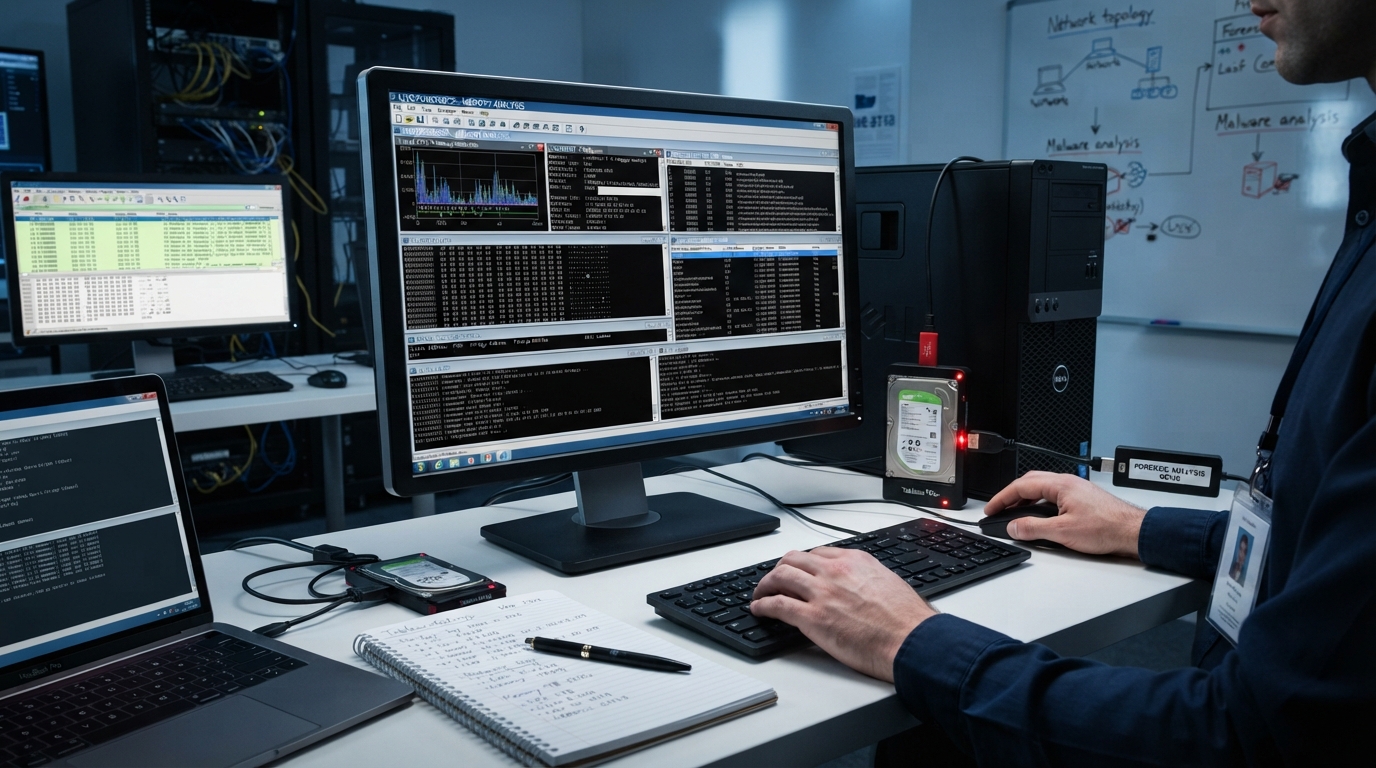
03 Live and Memory Forensics
What Is Live Forensics?
Live forensics involves examining a computer while it is still running. This matters because some important information exists only temporarily. Turning off a computer can destroy or change evidence stored in volatile memory, such as running processes, active network connections, logged-in users, encryption-related information, and memory-resident malware.
What Is Memory Forensics?
Memory forensics focuses on information stored in RAM. A memory image may contain evidence that is unavailable from a traditional disk image, particularly information associated with active processes and temporary system state. This has become increasingly important as malware makes greater use of techniques that leave fewer conventional files on disk.
04 Computer Forensics
Computer forensics involves identifying, acquiring, preserving and examining evidence from computers and storage media. A typical investigation may involve creating an image of storage media rather than examining the original disk directly.
What Is Forensic Imaging?
Forensic imaging is the process of creating a controlled copy of digital storage for examination. Depending on the acquisition method, it can include allocated files, deleted data, unallocated space, file-system information, slack space and metadata.
What Is Hashing in Digital Forensics?
Hashing is commonly used to help verify the integrity of digital evidence. A hash algorithm produces a value based on the contents of data. If the data changes, its hash value normally changes as well, allowing examiners to demonstrate that acquired evidence has remained consistent.
Modern Computer Forensic Tools
- FTK (Forensic Toolkit): A digital forensic investigation platform emphasizing large-scale evidence processing, indexing, search, artifact analysis, and reporting.
- X-Ways Forensics: An established platform used for low-level and file-system-oriented analysis, providing investigators with detailed control over disks, images and data structures.
05 Database Forensics
Database forensics involves examining databases and their associated files, logs and metadata to identify evidence of activity. Databases can be central to investigations involving financial fraud, employee misconduct, unauthorized changes, customer-data theft, manipulated transactions, compromised applications, and falsified records.
Why Are Database Logs Important?
A business database may contain the final record of a transaction, but supporting logs can provide the surrounding history. For example, a database record may show a payment amount was changed, but the related audit information indicates who changed it, when it changed, and which application or account performed the action. That context is far more valuable than the record alone.
06 Mobile Forensics
Mobile forensics involves acquiring and analyzing digital information from smartphones, tablets and related mobile systems. Phones contain an unusually rich record of activity because people use them for communication, authentication, payments, navigation, photographs, social media and work.
Mobile Forensic Acquisition Methods
- Logical Acquisition: The examiner obtains data available through supported operating-system or application interfaces.
- File-System Acquisition: A broader view of the device's file system is acquired where supported.
- Physical Acquisition: The examiner attempts to obtain a more direct representation of device storage where technically and legally possible.
- Backup & Cloud Acquisition: Existing device backups or relevant cloud data may also become part of an investigation where proper authority is available.
Current Mobile Forensic Platforms
MOBILedit Forensic
Supports physical and logical acquisition, application analysis, deleted-data recovery, cloud forensics and report generation.
Belkasoft X
Combines computer, mobile, RAM, and cloud forensics within one interface, including artifact extraction, timelines, and data carving.
Oxygen Forensic Detective
Supports mobile and computer forensic analysis, cloud and application data, and multi-source acquisition workflows.
Caution: Older Digital Forensic Tools
A major problem with older "best forensic tools" articles is that they copy historic research without checking whether the tools still represent current investigative practice. Before selecting any forensic tool, investigators should verify whether it is still maintained, its supported operating systems, security updates, forensic validation, and vendor documentation. An old tool should not automatically be presented as a current mainstream choice.
07 The Digital Forensic Investigation Process
Tools alone do not make an investigation reliable. The process surrounding them is equally important. A reliable framework consists of eight distinct phases:
Identification
Determine where potential evidence may exist (computer, mobile, network, cloud, database, etc.) to avoid overlooking relevant evidence.
Preparation
Determine required resources, choose appropriate tools, prepare forensic storage, confirm authority, and coordinate with specialists.
Investigation Strategy
Decide how to collect the maximum useful evidence while reducing unnecessary alteration or disruption (e.g., powered-on encrypted vs. powered-off device).
Preservation
Protect potential evidence from modification, deletion, contamination, unauthorized access, or accidental loss, maintaining chain-of-custody.
Acquisition
Collect relevant data using an appropriate forensic method (disk imaging, mobile extraction, memory acquisition, packet capture, etc.) and document it.
Examination
Process the acquired evidence to identify potentially relevant information through file-system parsing, indexing, deleted-file recovery, and keyword searching.
Analysis
Explain what the examined information means. Correlate login records, emails, file creation times, and payment records to reconstruct an event timeline.
Reporting and Presentation
Document findings clearly so another qualified person can understand what was examined, which tools were used, what was discovered, and what limitations exist.
08 Digital Forensic Tool Comparison
There is no universal "best forensic tool." The right tool depends on what the investigator needs to accomplish. The following table serves as an orientation guide rather than a ranking. Many forensic laboratories use multiple tools because one application may recover or interpret information differently from another.
| Tool | Main Use | Typical Investigation Value |
|---|---|---|
| Wireshark | Network packet analysis | Examining captured traffic, protocols and communications |
| Nmap | Network discovery and auditing | Identifying hosts, ports, services and network exposure |
| Nessus | Vulnerability assessment | Identifying vulnerabilities and configuration weaknesses |
| Xplico | Network forensic reconstruction | Extracting application data from captured network traffic |
| FTK | Computer/digital evidence analysis | Processing, indexing, searching and reviewing large evidence sets |
| X-Ways Forensics | Computer and storage forensics | Detailed disk, file-system and forensic-image analysis |
| MOBILedit Forensic | Mobile forensics | Phone acquisition, application analysis and reporting |
| Belkasoft X | Multi-source digital forensics | Computer, mobile, memory, cloud and artifact analysis |
| Oxygen Forensic Detective | Mobile and multi-source forensics | Mobile, application, computer and cloud evidence analysis |
Important Features to Compare
When evaluating tools, investigators should consider: Forensic Imaging capabilities, Hash Verification, Deleted Data Recovery, Data Analysis artifacts, Reporting formats, Packet Analysis, File-System Support, Mobile Acquisition methods, Application Support, Timeline Analysis, and Multi-Source Analysis capabilities.
Cybersecurity Tools
Primarily help organizations prevent, detect and respond to security problems in real-time.
Digital Forensic Tools
Focus more heavily on preserving and examining evidence to reconstruct past events for legal proceedings.
Why Should Investigators Validate Their Findings?
Forensic software is powerful, but automated output should not automatically be treated as unquestionable fact. Different applications may interpret artifacts differently, support different application versions, parse timestamps differently, or fail to recognize an artifact. Important findings should be understood and, where necessary, corroborated by examining the source artifact, comparing another evidence source, verifying timestamps, or using an additional forensic method.
Frequently Asked Questions About Digital Forensic Tools
A digital forensic tool is software or hardware used to acquire, preserve, recover, examine or analyze electronic information for investigative purposes.
Major areas include computer forensics, network forensics, mobile forensics, database forensics, live and memory forensics, and cloud forensics.
Tools used in network-related investigations include Wireshark and Xplico. Other tools such as Nmap provide network discovery and auditing information that can support an investigation.
Wireshark is primarily a network protocol analyzer, but it is widely useful in network forensic investigations because it allows detailed analysis of captured packets and communications.
Nmap is primarily a network discovery and security-auditing application. It may support forensic or incident-response work by identifying systems, ports and services, but it is not an evidence-recovery suite.
Nessus is primarily a vulnerability-assessment platform. It can support cyber incident investigations by identifying weaknesses in an environment, but it serves a different role from traditional forensic acquisition and analysis software.
Computer forensics generally focuses on desktops, laptops and storage systems. Mobile forensics focuses on smartphones, tablets, mobile operating systems, applications and associated data.
Forensic imaging creates a controlled copy of digital storage that can be examined while helping preserve the original source.
Hashing creates a digital value derived from data. Investigators can use hashes to help verify that evidence has remained unchanged between forensic stages.
Sometimes. The result depends on the storage technology, operating system, subsequent device activity and whether the relevant information has been overwritten.
Different tools have different strengths, support different devices and interpret artifacts differently. Using more than one method can also help verify important findings.
There is no single feature that applies to every investigation. Reliability, supported evidence sources, integrity controls, analysis capability, documentation and reporting all matter.
Conclusion
Digital forensic tools have become an essential part of cybercrime investigation, but selecting a tool should begin with the evidence—not the software. Network investigations may require packet analysis and traffic reconstruction. Computer investigations may require forensic imaging, deleted-file recovery and file-system examination. Mobile investigations may involve applications, messages, cloud records and multiple acquisition methods. Database and memory examinations bring their own technical requirements.
The tools have also evolved considerably. Applications that were once designed for one narrow type of evidence increasingly combine computer, mobile, cloud and memory analysis within a single investigative environment.
Yet the basic forensic principles remain the same: identify the evidence → preserve it → acquire it correctly → examine it → analyze it → document the findings.
No graphical interface, automated parser or large forensic platform replaces those fundamentals. The best forensic investigation is not the one that uses the largest number of tools. It is the one in which the examiner selects appropriate methods, protects evidence integrity, understands what the software is showing and connects the technical findings with the wider facts of the case.
And when those findings may ultimately be used in legal proceedings, technical analysis must work alongside proper evidence handling, chain of custody and legal procedure. For that part of the process, continue with our detailed guide to Digital Evidence in Cybercrime Investigations and Court Proceedings.
Need Expert Legal Help with a Cybercrime Case?
If you are dealing with digital fraud, unauthorized access, or require assistance with NCCIA complaints and PECA proceedings, our specialized legal team is here to protect your rights and guide you through the complex intersection of technology and law.
Schedule a Legal ConsultationSpecialized in Digital Forensics, PECA 2016 & NCCIA Proceedings