Hacking in Pakistan: PECA Law, Account Takeovers, Phone Hacking, Business Attacks and Legal Remedies
When people say an account has been “hacked,” they can mean very different things. Sometimes a hacker guesses or steals a password and logs into a Facebook or Instagram account. Sometimes malware is installed on a phone. In other cases, an employee copies company data, a criminal hijacks a WhatsApp account, or a business server is damaged through unauthorized access.
Account, Phone or Business System Hacked?
If an account, device or company system has been accessed without permission, preserve the evidence before it disappears and document what changed, what was copied and whether money or identity information was involved.

Pakistani cyber crime in Pakistan does not treat all of these situations as one single offence.
Under the Prevention of Electronic Crimes Act, commonly called PECA, the legal section depends on what actually happened. Unauthorized access is one offence. Copying or transmitting data is another. Damaging or interfering with a system is another. Identity misuse, electronic fraud and malicious code can also become relevant in the same incident.
That distinction matters because the penalties and legal procedure can change from one section to another.
Key Takeaways
- PECA separates unauthorized access, unauthorized copying or transmission, and interference with systems or data into different offences.
- A hacked social-media or email account can involve additional legal issues if identity information is misused or the account is used for fraud.
- Critical infrastructure hacking is legally distinct from an ordinary Facebook, Gmail or WhatsApp takeover.
- Victims should secure recovery channels quickly while preserving security emails, login alerts, device information and transaction records.
- Businesses should avoid wiping compromised systems before important logs and incident evidence are preserved.
- IP addresses and other technical indicators can assist an investigation but do not automatically identify the person responsible.
What Is Hacking Under Pakistani Cyber Crime Law?
“Hacking” is a common everyday word, but PECA uses more specific legal concepts.
The most basic offence is unauthorized access to an information system or data under Section 3. This applies where a person, with dishonest intention, gains access to a system or data without authorization.
Section 4 is different. It deals with unauthorized copying or transmission of data.
Section 5 deals with interference with an information system or data, including unauthorized conduct that damages or disrupts the system or information.
The current PECA text separates these offences clearly. Section 3 covers unauthorized access, section 4 covers unauthorized copying or transmission, and section 5 covers interference or damage. Pakistan Code
So a person who simply enters an account without permission may fall under one provision, while a person who then copies private files, deletes data or damages the system may face additional legal issues.
What Is the Punishment for Unauthorized Access in Pakistan?
Under Section 3, unauthorized access to an information system or data can carry imprisonment of up to three months, a fine up to Rs. 50,000, or both. Pakistan Code
This means that simply entering someone else's account without authorization can itself be an offence even if the hacker does not immediately steal money or delete anything.
The fact that someone knew the password does not automatically mean they were authorized to use it.
What if the Hacker Copies or Sends My Data?
Section 4 becomes relevant where a person, with dishonest intention and without authorization, copies or transmits data.
The punishment can extend to six months' imprisonment, a fine up to Rs. 100,000, or both. Pakistan Code
This can matter where someone enters an account and then copies:
- private messages
- photographs
- company files
- customer records
- documents
- account data
Unauthorized access and unauthorized copying are therefore legally different issues.
What if the Hacker Deletes, Changes or Damages Data?
If the person interferes with or damages an information system or data, Section 5 may apply.
The punishment can extend to two years' imprisonment, a fine up to Rs. 500,000, or both. Pakistan Code
This may become relevant where a hacker:
- deletes files
- changes account settings
- locks a user out
- damages a database
- alters stored information
- disrupts normal system operation
The legal focus is not just access, but interference with the system or data.
Critical Infrastructure Hacking Is Treated More Seriously
Critical infrastructure is covered separately under Sections 6, 7 and 8.
Section 6 deals with unauthorized access to critical infrastructure systems or data and can carry imprisonment up to three years and a fine up to Rs. 1 million.
Section 7 covers unauthorized copying or transmission of critical infrastructure data and can carry imprisonment up to five years and a fine up to Rs. 5 million.
Section 8 covers interference with critical infrastructure systems or data and can carry imprisonment up to seven years and a fine up to Rs. 10 million. Pakistan Code
This is why it is inaccurate to describe ordinary Facebook cyber crimes or Gmail hacking as “critical infrastructure hacking.” The critical infrastructure provisions apply to a different and more serious category of systems.
Someone Hacked My Facebook Account: What Should I Do?
The first goal is to recover and secure the account.
Meta's account recovery process is separate from the criminal complaint process. Facebook controls access to the account, while NCCIA investigates any criminal conduct connected with the takeover.
If you still have access, change the password immediately, remove unknown sessions and enable two-factor authentication.
If you are locked out, use Facebook's official hacked-account recovery process.
Then secure the email account connected to Facebook. A hacker who controls the recovery email may simply take the Facebook account again after you recover it.
If the hacker uses your profile to impersonate you, ask contacts for money, publish harmful content or commit fraud, preserve that evidence and consider an NCCIA complaint.
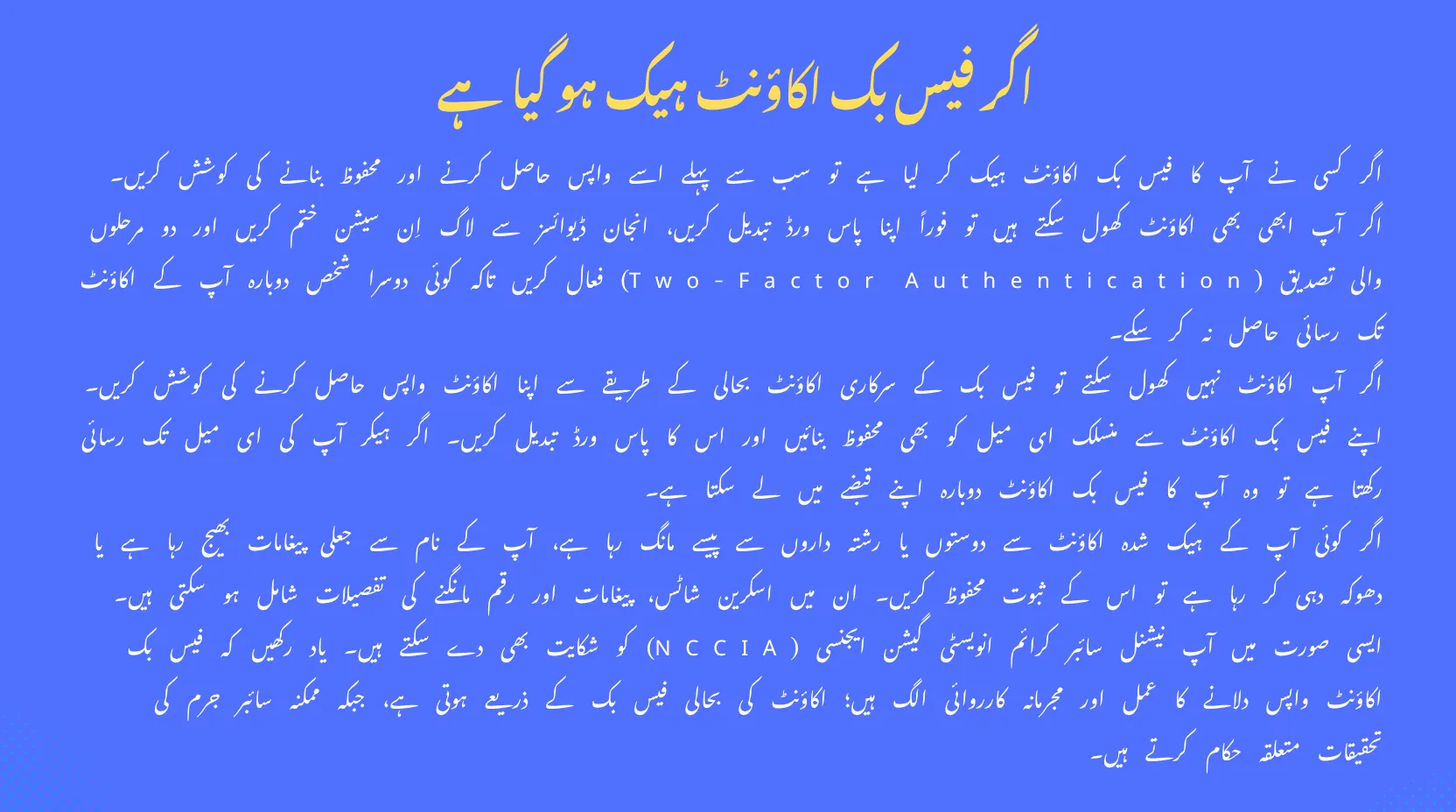
Facebook Account Taken Over and Used to Ask Friends for Money
This is more serious than simple unauthorized access.
A single incident can involve several offences.
Section 3 may apply to the unauthorized login.
Section 16 may become relevant if the person uses your identity information without authorization.
Section 14 may become relevant if the account is used to deceive people into sending money.
Section 16 currently provides imprisonment up to three years, a fine up to Rs. 5 million, or both for unauthorized use of another person's identity information. Section 14 electronic fraud can carry imprisonment up to two years, a fine up to Rs. 10 million, or both. Pakistan Code
The exact section depends on what the hacker did after gaining access.
Someone Hacked My Instagram Account: What Legal Remedy Is Available?
The practical response is similar.
First use Instagram's official recovery tools.
If you receive an email saying the account email address or password was changed, preserve that message before deleting anything.
Save:
- account username
- profile URL
- security emails
- login alerts
- changed email address
- changed phone number
- screenshots of unauthorized posts
- messages sent by the hacker
If the account was simply accessed without permission, Section 3 may be relevant.
If the hacker then impersonates you or uses your identity information, Section 16 may also become relevant.
If the account is used to collect money through deception, Section 14 may become relevant.
Why Instagram Security Emails Matter
A “password changed” or “email changed” notice can be very useful evidence because it may show when control of the account changed.
Do not rely only on screenshots of the hacked profile.
Preserve the complete security email, date, time and any device or location information shown.
If possible, keep the original email rather than forwarding or editing it.
WhatsApp Account Hacked: What Should You Do Immediately?
A WhatsApp cyber crime takeover can happen in several ways.
The attacker may obtain your SMS verification code.
They may gain access through a linked device.
They may take control of your SIM through SIM swapping.
They may also deceive you into sharing an OTP or verification code.
If you still control your phone number, re-register WhatsApp using your number and the verification code sent to you.
Check linked devices and remove any session you do not recognize.
Enable WhatsApp two-step verification.
Then inform close contacts that your account may have been compromised, especially if the hacker has been asking people for money.
WhatsApp Account Hacked and Used for Fraud
If the attacker only entered the account, Section 3 may be relevant.
If they impersonate you, Section 16 may become relevant.
If they use the account to deceive contacts into transferring money, Section 14 may also become relevant.
NCCIA currently identifies hacking, identity theft and financial fraud among the cybercrime categories it investigates, and its official complaint system lists helpline 1799. NCCIA
WhatsApp Account Cloned or SIM Swapped
People often use the word “cloned” for different problems.
Sometimes the issue is simply an unauthorized linked device.
Sometimes the attacker has gained control of the phone number itself through a SIM swap.
If you suspect SIM swapping, contact the telecom operator immediately.
Ask whether a replacement SIM or other change was issued without your authorization.
Secure the mobile number first because many other accounts may use that number for password recovery.
Then change passwords for:
- banking apps
- social media
- cloud accounts
A stolen phone number can become the starting point for multiple account takeovers.
Someone Is Using My WhatsApp Account Without Permission
Preserve evidence before the account is fully recovered.
Useful material includes:
- screenshots of messages sent by the hacker
- linked-device information
- login alerts
- SIM replacement information
- messages from contacts
- payment requests
- wallet or bank details provided by the hacker
If money was requested from contacts, ask them to preserve their own chats and transaction information.
Their evidence may show what the attacker did after taking over your account.
Gmail Account Hacked: Can You Take Legal Action?
Yes, where the facts satisfy the requirements of PECA.
Unauthorized entry into a Gmail or other email account can fall under Section 3.
If the attacker copies or sends information from the account, Section 4 may become relevant.
If they delete, alter or damage data, Section 5 may apply.
If they use the account to commit financial fraud, Section 14 may also become relevant.
This is a better legal distinction than treating every email hack as automatically involving one single section.
Email Account Hacked: What Should You Do First?
Recover the account using the provider's official recovery system.
Then secure the recovery email address and phone number.
Check:
- recent logins
- recovery addresses
- forwarding rules
- filters
- connected applications
- unknown devices
Attackers sometimes add email-forwarding rules so they can continue receiving copies of messages even after the password is changed.
Remove anything you do not recognize.
Someone Logged Into My Social Media Without Permission
A login without permission can itself be legally significant.
Section 3 does not require the victim to first prove that money was stolen.
It focuses on dishonest unauthorized access to an information system or data. Pakistan Code
However, evidence still matters.
A security alert showing an unfamiliar login is useful, but it does not always identify the person responsible.
The investigation may need to connect:
- account logs
- device information
- IP records
- phone numbers
- other evidence
Password Stolen and Account Misused
A stolen password can lead to several different offences depending on how it is used.
If the password is used to enter the account, Section 3 may apply.
If personal identity information is then used without authority, Section 16 may become relevant.
If the account is used to deceive someone for financial gain, Section 14 may apply.
The password itself is therefore only part of the case.
The stronger complaint explains what the offender actually did after obtaining it.
Someone Is Trying to Hack My Account but Has Not Succeeded
Do not ignore repeated unauthorized login attempts.
Preserve:
- failed login emails
- OTP requests
- password reset messages
- new-device alerts
- suspicious recovery requests
Then change the password and enable two-factor authentication.
A failed login attempt is not automatically the same as a completed Section 3 offence, because the statutory offence requires unauthorized access to have been gained.
The legal treatment of an attempted offence can depend on the wider criminal law framework and the facts, so it is better not to describe every failed login alert as a completed hacking offence.
You can still report suspicious activity where there is a genuine and repeated threat.
Someone Hacked My Phone: How Do I Know?
A phone behaving strangely does not automatically prove hacking.
Battery drain, heat, pop-ups or slow performance can have ordinary technical causes.
More meaningful signs may include:
- unknown applications
- unexpected administrator privileges
- unrecognized linked accounts
- unexplained SMS activity
- password reset messages you did not request
- security alerts from unknown devices
- remote-control applications you did not install
Do not install random “spyware detector” applications simply because you suspect compromise.
If the matter is serious, preserve the device and seek competent technical examination.
What Evidence Should You Preserve After Phone Hacking?
Save:
- security alerts
- suspicious application names
- screenshots
- unexpected OTP messages
- unrecognized outgoing calls or SMS
- ransom messages
- email login notifications
- account takeover messages
But remember that screenshots alone do not necessarily explain how the compromise occurred.
A digital forensic tools may be necessary to identify malware, suspicious files or system activity.

Malware and Malicious Code Under PECA
Section 23 deals specifically with malicious code.
It applies where a person willfully and without authorization writes, offers, distributes or transmits malicious code with intent to cause harm resulting in corruption, destruction, alteration, suppression, theft or loss of a system or data.
The punishment can extend to two years' imprisonment, a fine up to Rs. 1 million, or both. Pakistan Code
This provision may become relevant in cases involving harmful software, but not every suspicious app automatically proves a Section 23 offence.
Phone Hacking and Spyware
Spyware cases can involve more than unauthorized access.
If software secretly intercepts communications, Section 19 on unauthorized interception may also become relevant depending on the conduct.
Section 19 covers unauthorized interception by technical means and can carry imprisonment up to two years, a fine up to Rs. 500,000, or both. Pakistan Code
The exact legal classification depends on what the software actually did.
Computer Hacking in Pakistan: How Does the Legal Process Work?
The process normally begins with a complaint and evidence.
NCCIA is the current federal agency responsible for investigation of PECA offences. Its official website lists cyber investigation, digital forensics and prosecution among its functions. NCCIA
A useful complaint should explain:
- what system was compromised
- when you discovered it
- what changed
- whether data was copied
- whether money was lost
- whether any suspect is known
- what evidence has been preserved
NCCIA's official complaint materials also state that a complaint proforma can be submitted with relevant supporting evidence to the appropriate office. NCCIA
Does Every NCCIA Complaint Immediately Become an FIR?
No.
A complaint can lead to inquiry and investigation, but it is not accurate to say that every report automatically results in an FIR, arrest or seizure.
The legal process depends on:
- the offence alleged
- the available evidence
- whether the offence is cognizable
- investigative findings
- procedural requirements
This distinction is important.
Are All Hacking Offences Cognizable and Non-Bailable?
No.
Under the current Section 43, most PECA offences are generally non-cognizable, bailable and compoundable unless specifically placed in the exception list.
Sections 13 and 14 are among the current cognizable and non-bailable offences, but ordinary Sections 3, 4 and 5 are not in that special list. Pakistan Code
So a case involving only unauthorized access may have a different procedural position from a hacking case that also involves electronic fraud.
Hacked Account Used for Financial Fraud
Suppose someone gains access to a Facebook account and starts asking the victim's contacts to send money.
The case may begin as unauthorized access.
It may then become identity misuse.
Once financial deception occurs, electronic fraud may also be involved.
This is why the correct legal analysis follows the conduct step by step rather than applying every PECA section automatically.
Unauthorized Access to a Computer or Mobile Phone
The same basic legal principles apply beyond social media.
A laptop, company server, smartphone, database or online account may all fall within PECA's concept of an information system or data, depending on the circumstances.
Section 3 focuses on unauthorized access.
Section 4 focuses on unauthorized copying or transmission.
Section 5 focuses on interference or damage.
These provisions form the basic legal structure for many hacking cases. Pakistan Code
Cyber Attack on a Business in Pakistan
A business cyberattack can be far more complex than an individual account takeover.
The first priority should usually be containment without destroying evidence.
A company may need to:
- isolate compromised systems
- secure administrator credentials
- preserve server logs
- preserve firewall records
- keep intrusion alerts
- record affected systems
- secure backups
Do not immediately wipe compromised servers unless there is a clear incident-response reason to do so.
The logs may contain the best evidence of how the attacker entered.

Why Businesses Should Preserve Logs Before Cleaning Systems
Once a compromised server is rebuilt, important evidence may disappear.
Useful records can include:
- login history
- IP addresses
- authentication failures
- file changes
- administrator actions
- network connections
PECA itself requires investigators dealing with seized digital systems to take measures to preserve integrity and chain of custody. Pakistan Code
The same principle is useful for businesses handling their own incident response.
Corporate Data Theft in Pakistan
Corporate data theft should not automatically be described as Section 5.
The correct section depends on the conduct.
If someone accessed the system without authorization, Section 3 may be relevant.
If they copied or transmitted company data without authorization, Section 4 may be particularly relevant.
If they damaged or interfered with the system, Section 5 may apply.
If they used stolen information to commit fraud, other provisions may also become relevant.
This distinction is important because “data theft” can involve several different acts.
Employee Stole Company Data: Is It Cybercrime?
Possibly.
Employee cases are more complicated because the person may originally have had legitimate access.
Suppose an employee was authorized to view a customer database as part of their job.
That does not necessarily mean they were authorized to copy the entire database onto a personal drive and send it to a competitor.
The legal question becomes:
What access was authorized, and what conduct went beyond that authorization?
A company should preserve:
- access-control records
- employment role
- system logs
- file transfer records
- USB activity
- email records
- NDA or confidentiality terms
The technical evidence should be compared with the employee's actual permission level.
Employee Access Versus Unauthorized Access
This is one of the most important distinctions in corporate hacking cases.
A person can have permission to enter a system but still lack permission to copy, transfer, delete or misuse particular data.
Therefore the case should not be reduced to:
“He had the password, so it was authorized.”
Authorization has a scope.
The evidence should show what the employee was permitted to do and what they actually did.
Ransomware and Hacking
Ransomware can involve several PECA issues.
A ransomware attacker may:
- gain unauthorized access
- copy data
- encrypt or damage data
- deploy malicious code
- demand payment
Depending on the facts, Sections 3, 4, 5 and 23 may become relevant, along with other laws where extortion or financial demands are involved.
A victim should preserve the ransom note, wallet address, affected files and relevant system logs.
What if a Hacker Changes My Bank or Payment Details?
This can be particularly serious for businesses.
An attacker who enters a company account and changes payment instructions may redirect genuine customer payments.
Preserve:
- original account details
- unauthorized new account details
- change history
- email notifications
- administrator logs
- customer communications
If deception is used to obtain money, Section 14 electronic fraud may become relevant in addition to the underlying unauthorized access. Pakistan Code
What Evidence Is Most Useful in a Hacking Complaint?
Good evidence usually tells a sequence.
Keep:
- security alerts
- login notifications
- password-change emails
- IP logs where available
- profile URLs
- device details
- screenshots of unauthorized activity
- emails from service providers
- transaction records
- chats with the attacker
- ransom demands
- server logs
- firewall logs
- malware scan results
Avoid editing the only copy of important evidence.
Where possible, keep original files and exports.
Why IP Addresses Do Not Automatically Identify the Hacker
An IP address can be useful.
But it does not automatically prove who was sitting behind the device.
An IP may belong to:
- a household
- office
- public Wi-Fi network
- VPN
- proxy
- mobile network
Investigators usually need additional records to attribute activity to a particular person.
This is why technical evidence should be interpreted carefully.
Can NCCIA Trace a Hacker?
NCCIA has cyber investigation and digital forensic functions and may obtain evidence through lawful investigative procedures. NCCIA
But no agency can honestly guarantee that every hacker will be identified.
Attribution depends on what records exist, whether they can lawfully be obtained, whether they have been preserved and how effectively the attacker concealed their identity.
Why Fast Reporting Matters
digital evidence in cyber crime cases can disappear.
Logs may be overwritten.
Accounts may be deleted.
Platforms may retain information only for limited periods.
PECA provides for expedited preservation of data where an authorized officer considers it reasonably required for a criminal investigation and at risk of being modified, lost or destroyed. Pakistan Code
This is one reason victims should preserve their own evidence and report serious incidents without unnecessary delay.
How to File an NCCIA Complaint for Hacking
A strong complaint should be chronological and specific.
Explain:
- 01what account, device or system belonged to you
- 02when you last had normal control
- 03what unauthorized activity you noticed
- 04what was changed, copied or deleted
- 05whether your identity was misused
- 06whether money was requested or stolen
- 07what evidence you have
NCCIA currently lists hacking and unauthorized access as cybercrime categories and provides complaint reporting through its portal and helpline 1799. NCCIA
What Should You Do Immediately After an Account Is Hacked?
Secure the recovery email first if it may also be compromised.
Then change the password.
Enable two-factor authentication.
Remove unknown sessions and linked devices.
Review recovery phone numbers and email addresses.
Preserve security alerts.
Warn contacts if the hacker has been sending messages in your name.
If financial accounts are involved, contact the relevant bank or wallet provider immediately.
How to Protect Your Accounts From Hacking
Most account takeovers do not require a movie-style technical attack.
Many begin with:
- reused passwords
- phishing links
- stolen OTPs
- fake login pages
- compromised email
- SIM swapping
Use a unique password for important accounts.
Enable two-factor authentication.
Do not give OTPs or recovery codes to anyone.
Review active sessions regularly.
Keep the recovery email account especially secure.
Your email is often the key to resetting every other password.
Frequently Asked Questions About Hacking in Pakistan
Yes. Unauthorized access, copying or transmission of data, interference with systems and related conduct are covered by PECA where the statutory requirements are satisfied.
Section 3 covers dishonest unauthorized access to an information system or data. Pakistan Code
Up to three months' imprisonment, a fine up to Rs. 50,000, or both. Pakistan Code
Section 4 deals with unauthorized copying or transmission of data, not critical infrastructure hacking. Pakistan Code
Section 5 deals with interference with or damage to an information system or data. Pakistan Code
Sections 6, 7 and 8 deal with unauthorized access, unauthorized copying or transmission and interference involving critical infrastructure. Pakistan Code
Use Facebook's recovery process, secure the linked email, remove unknown sessions, enable two-factor authentication and preserve evidence of any misuse.
Yes, where the facts disclose a PECA offence such as unauthorized access, identity misuse or fraud.
Re-register your number, remove unknown linked devices, enable two-step verification, warn contacts and report criminal misuse where necessary.
The legal issue depends on how the password was obtained and used. Unauthorized use of the password to enter an account may fall under Section 3.
Potentially, depending on their authorization and what they copied, transmitted or misused.
Section 23 specifically criminalizes certain willful distribution or transmission of malicious code intended to cause harm. Pakistan Code
No. Ordinary Sections 3, 4 and 5 are not in the current Section 43 special list of non-bailable and cognizable offences. Pakistan Code
An IP address can assist an investigation, but by itself it does not always identify the individual responsible.
You can report serious repeated unauthorized login attempts and preserve the alerts, but a failed login should not automatically be described as a completed Section 3 offence.
Hacking Under Pakistani Cyber Crime Law
Hacking under Pakistani cybercrime law is not one single offence.
The law separates the conduct into different acts.
Unauthorized access falls under Section 3.
Unauthorized copying or transmission of data falls under Section 4.
Interference or damage falls under Section 5.
Critical infrastructure has its own stronger provisions under Sections 6 to 8.
Identity misuse, financial deception and malicious code may bring Sections 16, 14 and 23 into the same case where the facts support them.
Need Help After a Hacking Incident?
Secure the affected account or system, preserve the original evidence, and document the incident clearly before taking the next reporting or legal step.
Contact Qanooni Rah