Money Mule Fraud in 2026: How It Works, How Banks Detect It, Red Flags and What to Do
Money mule fraud is one of the least understood parts of modern financial crime. The person moving the money may not be the original scammer. They may never have spoken to the victim and, in some cases, may not even realize that they are helping criminals. Yet their bank account, mobile wallet, cryptocurrency account or payment service can become the bridge between the victim and the criminal network. That is what makes money mule operations so effective. Fraudsters use mules to make stolen money harder to trace, move funds across several accounts, convert money into cash or cryptocurrency, and create distance between themselves and the original fraud. Money mule networks are now closely connected withonline fraud, romance scams, investment scams, business email compromise and othercyber crime. Your source correctly describes the mule as an intermediary who receives illicit funds and moves them onward, often helping criminals hide the money trail.

Key Takeaways
- A money mule is an intermediary who receives, transfers, withdraws or converts funds obtained through crime for another person or group.
- Some mules knowingly participate, while others are recruited through fake jobs, romance scams, investment schemes or business opportunities.
- Banks increasingly detect mule activity through behavior, transaction velocity, device data, login patterns and economic context rather than one transfer amount.
- Rapid movement of funds, unrelated incoming payments, immediate cash-outs and unexplained cryptocurrency purchases are common warning signs.
- If unexpected money appears in an account, the safest first step is to contact the financial institution rather than forwarding or returning the money independently.
- Evidence preservation matters: messages, transaction IDs, account details, job advertisements and recruiter communications can become important later.
What Is Money Mule Fraud?
Money mule fraud happens when a person receives, transfers, withdraws or otherwise moves money obtained through crime on behalf of another person or group. The funds may pass through a personal bank account, mobile wallet, cryptocurrency exchange, money-transfer service, prepaid card, business account or newly opened company.
The mule may keep a percentage as commission or may genuinely believe they are performing legitimate work. In many cases, the criminal never explains the true source of the money. Instead, the person is told they are helping with payments, receiving client funds, assisting a business partner or carrying out a remote job.
Is a Money Mule a Victim or a Criminal?
A money mule can be either an unwitting victim or a willing participant. Some people are deceived through fake work-from-home offers, romance scams or investment schemes. They believe they are helping an employer, partner or client. Others may notice suspicious signs but continue moving money because they are being paid. In more serious cases, a person knowingly rents out bank accounts, opens accounts for criminals, withdraws cash or converts stolen funds into cryptocurrency.
The legal position depends on the jurisdiction and on what the person knew, suspected or deliberately ignored. Being unaware at the beginning does not always remove all legal risk, especially if warning signs become obvious and the activity continues.
Why Criminals Use Money Mules
Criminals use money mules to break the direct link between stolen money and the people who committed the original fraud. If a fraudster steals money from a victim and transfers it directly into their own account, the trail is easier to follow. When several mule accounts are used, the route becomes more complicated.
For example, money may move from the victim to one mule account, then to another bank account, then into cryptocurrency, and finally be withdrawn as cash. Every extra step creates more distance from the original crime and makes the investigation more difficult.
Money mules can also help criminals avoid using their own identity, bypass account limits, move funds between countries and create the appearance of ordinary commercial activity.
How People Are Recruited as Money Mules
Money mule recruitment is usually based on trust, urgency or the promise of easy money. Criminals rarely tell someone that they are being recruited to move stolen funds. Instead, the arrangement is disguised as a job, business opportunity, relationship or investment activity.
One common method is a fake work-from-home job. A person may be offered a role such as payment processing assistant, finance agent, account coordinator, remote administrator or data-entry clerk. The so-called employee is then told that company payments will arrive in their personal account and that they need to forward the money after keeping a commission.
Another common method is romance fraud. In these cases, the scammer spends time building emotional trust. After the relationship feels genuine, they say they cannot receive money directly because of a business problem, emergency, banking restriction or tax issue. The victim is asked to receive money and send it elsewhere. The person may think they are helping someone they love, while the money may actually belong to other fraud victims.
Investment and cryptocurrency scams can work in a similar way. A person may be told that they are helping process crypto settlements, overseas withdrawals or investment payments. The money may be received through a bank account and then converted into cryptocurrency.
Fake Jobs
Remote payment-processing, finance-agent or account-coordinator roles that require a personal bank account.
Romance Fraud
A supposed partner asks the victim to receive or forward money because of an emergency or banking problem.
Investment & Crypto
The person is told they are helping with settlements, overseas withdrawals or cryptocurrency payments.
Social Platforms
Recruitment may begin through Facebook, Instagram, Telegram, TikTok, WhatsApp, LinkedIn or job boards.

Money Mule Fraud and Social Media
Social media and messaging platforms have made recruitment easier. Criminals can approach potential mules throughFacebook cyber crimes, Instagram, Telegram, TikTok,WhatsApp cyber crime, LinkedIn and online job boards.
The offer usually sounds attractive. It may promise flexible hours, remote work, quick commissions or no previous experience. The strongest warning sign is when the “job” mainly requires the person to use their own personal bank account, wallet or crypto account to move money on behalf of someone else.
Fraud Types Commonly Connected With Money Mules
Money mule operations usually support another type of fraud. They are common in phishing cases, account takeover, fake invoice fraud, authorized push payment scams and business email compromise. They are also widely used in identity theft, impersonation, investment fraud, romance fraud ande-commerce fraud and online shopping scams.
Fake online shops may use mule accounts to receive customer payments while keeping the real operators hidden. Investment scams may send victims to different bank accounts controlled by mules. Romance scammers may turn their own victims into money movers.
This is why money mule fraud is often not a separate scam but part of a wider criminal system.
Major Fraud Trends in 2026
Money mule operations are becoming harder to detect because criminals are using more advanced tools. AI-generated voices, deepfake videos and personalized phishing messages can make fake recruiters, fake executives and fake romantic partners look far more convincing.
Synthetic identity fraud is also a growing concern. Criminals may combine real and fake identity information to create an identity that appears legitimate enough to open accounts or pass basic checks. Once an account has established a normal-looking history, it may later be used for fraud.
QR code fraud and manipulated payment links are another growing risk. Victims may believe they are paying one merchant or service while funds are redirected elsewhere. Authorized push payment scams are particularly dangerous because the victim is manipulated into sending the money themselves.
The Fraud Triangle
The fraud triangle is often used to explain why people become involved in fraud. It is based on three ideas: pressure or incentive, opportunity and rationalization.
Pressure may involve debt, unemployment, financial stress or greed. Opportunity exists when a person believes there is a weakness in a system or that they can move money without being caught. Rationalization is the internal explanation used to justify the conduct, such as “I am only moving money” or “I do not know where it came from.”
The fraud triangle is useful, but it does not explain every money mule case. Some people are manipulated rather than motivated by ordinary fraud incentives.
How Banks Detect Money Mules
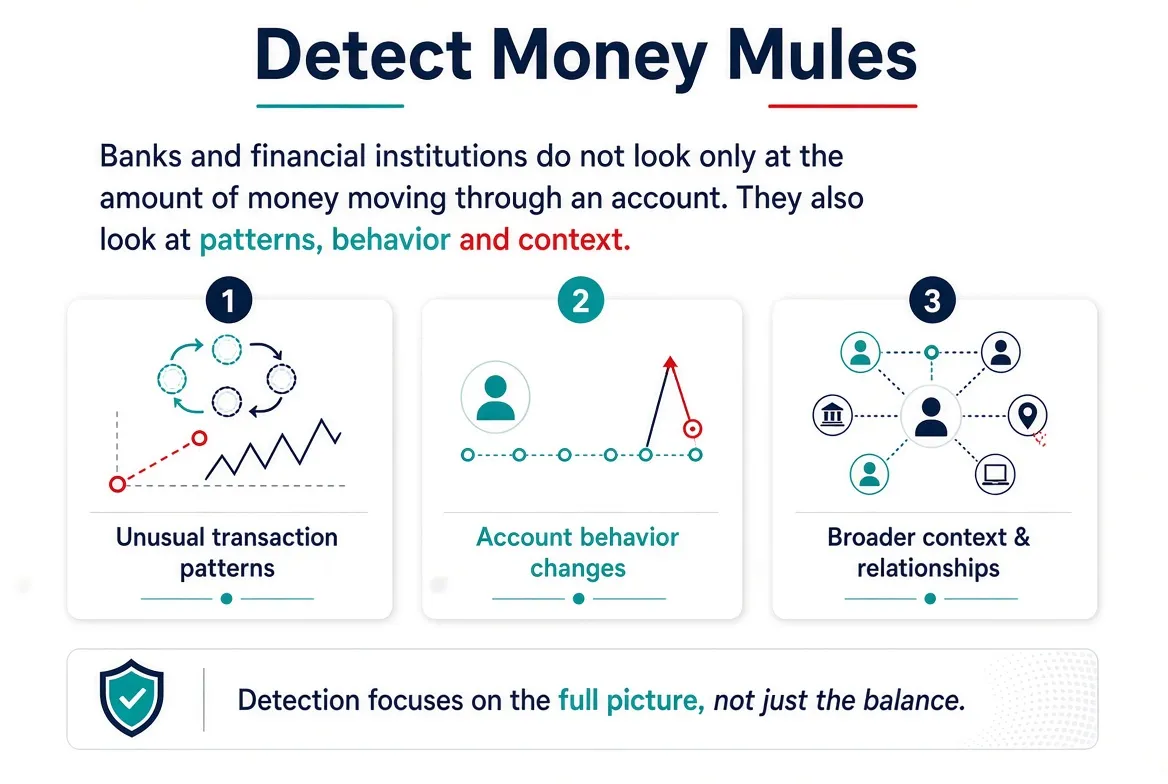
Banks and financial institutions do not look only at the amount of money moving through an account. They also look at patterns, behavior and context.
An account that has been inactive for months may suddenly begin receiving several large payments. Money may arrive and leave within minutes. A personal retail account may suddenly begin receiving transfers from unrelated third parties. Funds may be withdrawn immediately, broken into smaller transactions or converted into cryptocurrency.
Banks may also examine device information, IP addresses, login locations and access patterns. If several accounts are repeatedly controlled from the same device or network, that may raise concern.
Your source correctly identifies behavioral anomalies, rapid transaction velocity, geographic irregularities and device fingerprinting as important indicators of possible mule activity.
Common Red Flags of a Money Mule Account
A money mule account often looks different from the account holder's normal financial behavior. Warning signs include sudden large transfers, payments from several unrelated people, rapid outward transfers, international transactions with no clear explanation, immediate cash withdrawals, cryptocurrency purchases and activity that does not match the person's usual income or occupation.
A personal account used like a commercial payment-processing account can also attract attention. The question is not only how much money is moving, but whether the activity makes economic sense.
Sudden large or repeated incoming payments from unrelated people
Money arriving and leaving within minutes or hours
Immediate cash withdrawals or cryptocurrency purchases
International transfers with no clear explanation
A personal account being used like a business payment-processing account
Activity that does not fit the account holder’s normal income, occupation or history
Placement, Layering and Integration
Money laundering is often described in three stages: placement, layering and integration.
Placement is the stage where illicit money first enters the financial system. Layering involves moving that money through several transactions to hide its origin. Money mules are especially useful during this stage because each additional transfer creates another layer. Integration is the stage where the money is eventually reintroduced as apparently legitimate wealth.
In modern digital fraud, these stages may happen very quickly and can overlap.
Is There a Minimum Amount for Suspicious Activity?
There is no single amount that automatically decides whether an activity is suspicious. A small transfer can still raise concern if it forms part of an unusual pattern.
For example, several small incoming payments from unknown people followed by immediate transfers may be more suspicious than one large transfer with a clear business explanation.
Financial institutions may have separate regulatory thresholds for mandatory reporting, but suspicious activity monitoring is based heavily on behavior, context and transaction patterns.
Can AI Detect Fake Bank Statements?
AI-assisted document verification can help identify suspicious bank statements and altered financial documents. Systems may examine PDF metadata, layout differences, inconsistent fonts, impossible balances, image alterations and irregular formatting.
However, AI should not be treated as perfect proof. A suspicious result should normally lead to further review rather than an automatic conclusion that the document is fraudulent.
How to Know if a Job Offer Is a Money Mule Scheme
A job offer should immediately raise concern if it asks you to receive company money into your personal bank account, forward funds to strangers, buy cryptocurrency, withdraw cash or keep a percentage of every transfer.
A genuine employer should have its own financial infrastructure and a clear commercial reason for how money is handled.
Before accepting such a role, ask why the company cannot use its own bank account, whether it is legally registered, whether there is a proper employment contract and why you personally need to route money through your account.
If the answers are vague, stop before any money is moved.
How to Verify a Foreign Company or Payment Request
If a company claims to be based overseas, check it independently through the official corporate registry of the country where it says it is registered. Do not rely only on a website or a WhatsApp conversation.
Check the domain, business email, contact information and office details. A company that communicates only through messaging apps and refuses independent verification should be treated cautiously.
Payment instructions should also be checked through official channels. Screenshots and messages alone are not enough to confirm who owns an account.
What to Do If You Receive Money From an Unknown Person
If money unexpectedly appears in your account, do not immediately transfer it, withdraw it or send it to another account provided by the sender.
Contact your financial institution and explain what happened. Let the bank handle any reversal through its official process. Keep the transaction record and any communication connected with the payment.
This reduces the risk of unknowingly becoming involved in another fraud.
What to Do If You Suspect You Are Being Recruited as a Money Mule
If you become suspicious, stop before receiving or moving any more money.
Do not withdraw the funds, forward them, convert them to cryptocurrency or follow further instructions from the recruiter.
Preserve the job advertisement, messages, email addresses, phone numbers and payment instructions. Report the fake job or profile to the platform where it appeared.
What If You Have Already Acted as a Money Mule?
If you have already moved money, stopping immediately is still important.
Contact your bank and explain the situation accurately. Preserve all chat history, transaction IDs, emails, phone numbers and account information.
Then seek legal or law-enforcement guidance in your jurisdiction.
Continuing to move money after becoming suspicious can make the situation worse.
Stop
Do not receive, forward, withdraw or convert any more money once the arrangement becomes suspicious.
Contact the Bank
Explain the situation accurately and use the bank’s official process for any reversal or review.
Preserve Evidence
Keep messages, transaction IDs, account details, phone numbers, emails and job advertisements.
Report
Report the fake job, account or profile to the platform and seek appropriate legal or law-enforcement guidance.
Why Self-Reporting Matters
Someone who was tricked into moving criminal funds should not assume that staying silent will protect them.
Financial institutions may identify the activity independently. Early reporting can help show when the person became suspicious, whether they stopped immediately, whether they cooperated and whether they preserved evidence.
Self-reporting does not automatically remove legal liability, but it can become important when investigators assess the person's knowledge and conduct.
Can an Unwitting Money Mule Still Face Legal Problems?
Yes.
Different countries apply different criminal laws, but investigators may examine what the person knew, what warning signs were present, whether they ignored those signs and whether they continued after becoming suspicious.
They may also look at whether the person profited from the transfers.
The difference between an innocent victim and a willing participant often depends on the surrounding facts.
The Role of KYC and AML Controls
Banks use Know Your Customer and Anti-Money Laundering controls to reduce the risk of mule activity.
These systems may include identity verification, transaction monitoring, source-of-funds checks, sanctions screening, device intelligence and behavioral analysis.
The purpose is not simply to confirm who opened the account. Banks also want to understand whether the way the account is being used fits the customer's expected financial profile.
Why Money Mule Networks Are Difficult to Investigate
Money mule networks are designed to create distance between the original fraud and the final destination of the funds.
A single payment may move through several banks, multiple jurisdictions, cryptocurrency exchanges and cash withdrawals. Some mules may know each other, while others may have no connection at all.
One criminal group can control many mules at the same time.
This makes cooperation between financial institutions, payment providers and law enforcement extremely important.
Money Mules and Cryptocurrency
Cryptocurrency is increasingly used in mule schemes because it allows value to move quickly across borders.
A mule may receive money into a bank account, buy cryptocurrency and then send it to another wallet.
The blockchain may preserve the transaction path, but identifying the person behind a wallet often requires additional evidence from exchanges, devices, emails or other records.
Tracing funds and identifying a person are not the same thing.
Money Mule Romance Fraud
Romance mule fraud deserves special attention because the victim may genuinely believe the relationship is real.
The scammer may say that their account is frozen, they are abroad, a client needs to pay them or they cannot receive funds directly. The victim is then asked to receive money and forward it elsewhere.
The person may believe they are helping a partner, but in reality they may be moving money stolen from other victims.
Money Mule Fraud and Older Victims
Older adults can be particularly vulnerable to romance, investment and confidence scams.
In some cases, the person first loses their own money and is later persuaded to help move money for the same criminal.
This creates a difficult situation where a person can be both a victim and part of the financial chain.
How Financial Institutions Can Reduce Money Mule Activity
Financial institutions can reduce mule risk through stronger onboarding, transaction monitoring, device profiling, behavioral analytics, customer warnings and rapid intervention.
The most effective systems do not rely on a single alert. They look at combinations of behavior, such as unusual account activity, repeated incoming payments, rapid cash-out and device connections.
Prevention, Detection and Response
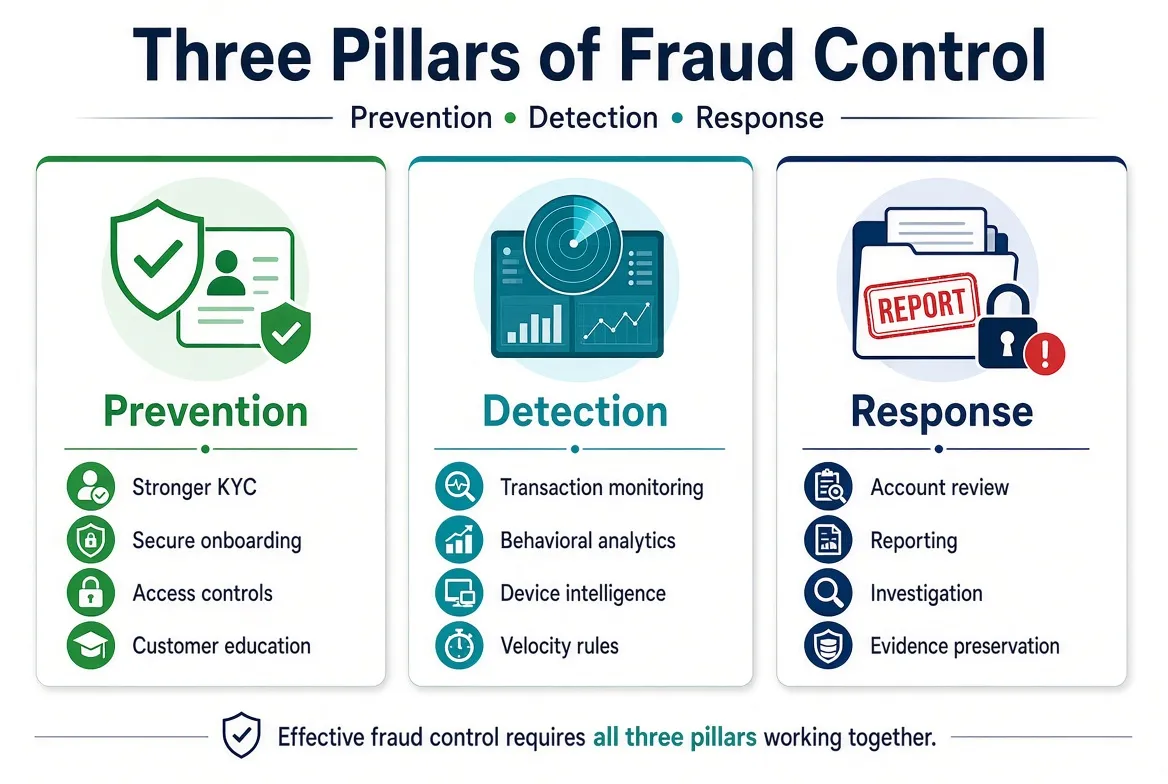
A practical fraud-control model can be understood through three areas: prevention, detection and response.
Prevention focuses on stopping mule activity before money moves through stronger KYC, secure onboarding, access controls and customer education.
Detection focuses on recognizing suspicious activity through transaction monitoring, behavioral analytics, device intelligence and velocity rules.
Response begins once risk is identified and may involve temporary holds, account review, reporting, investigation and evidence preservation.
Your source correctly frames prevention, detection and response as the three main practical pillars of fraud control.
Stronger KYC, secure onboarding, access controls and customer education.
Transaction monitoring, behavioral analytics, device intelligence and velocity rules.
Account review, reporting, investigation and evidence preservation once risk is identified.
Frequently Asked Questions About Money Mule Fraud
A money mule is a person who receives, transfers or withdraws money obtained through crime on behalf of someone else.
Yes. Many people are recruited through fake jobs, romance scams or investment opportunities.
They use mules to create distance between themselves and stolen money, making tracing and investigation more difficult.
Common signs include sudden incoming payments, multiple unrelated senders, rapid outward transfers, unexplained cash withdrawals and activity that does not fit the account holder's normal profile.
Yes. Banks use transaction monitoring, behavioral analysis, device information and fraud-detection systems.
Yes. A scammer may persuade the victim to receive and forward money belonging to other victims.
Do not move it. Contact your bank and let the bank handle any reversal through its official process.
Do not send it to another account or wallet supplied by the sender. Contact your financial institution first.
Do not proceed until the company and the reason for the request have been independently verified.
Stop further transactions, contact your bank, preserve all evidence and seek legal or law-enforcement guidance.
Yes. Stolen funds may be converted into cryptocurrency and transferred to other wallets.
Yes. Suspicion depends on the pattern and purpose of the transaction, not only its value.
Money Mule Fraud in 2026
Money mule fraud sits at the center of many modern financial scams.
The mule may not create the phishing message, fake investment website or romance profile. Their role is to move the money and help separate the criminal network from the original victim.
Some mules understand exactly what they are doing. Others are recruited through fake jobs, relationships or business opportunities and only realize later that their account has been used to move criminal funds.
The most important warning sign is simple. If another person wants to use your personal bank account, wallet or cryptocurrency account to receive and forward money, stop and verify the arrangement before doing anything.
A genuine job should have a clear business purpose. A legitimate employer should not need your private bank account as its payment-routing system. A genuine romantic partner should not need you to move unexplained money for strangers.
For banks and investigators, money mule detection is no longer about one large transfer. It is about behavior and patterns.
Who sent the money? How quickly did it move? Where did it go? Does the activity match the account holder's normal financial profile? Is there a genuine commercial purpose?
Those questions are at the heart of modern money mule detection.
The strongest defense against money mule fraud is the combination of careful verification, behavioral monitoring, rapid reporting and public awareness.
Think Your Account May Have Been Used in Fraud?
Stop further transfers, preserve the evidence, contact your financial institution and seek appropriate legal or law-enforcement guidance before taking further action.
Contact Qanooni Rah